

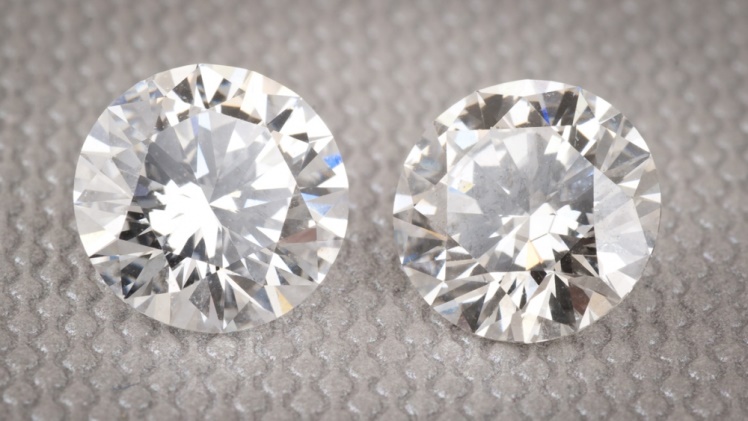
Lab-created diamonds appear identical to mined ones, and traditional gemological examinations and old-style Lab diamonds detectors cannot distinguish between the two.
Lab-grown diamonds appear chemically and optically identical to their natural counterparts, making them impossible to differentiate without specialized equipment.
It’s impossible for jewellers to detect lab diamonds with the naked eye.
Contrary to popular belief, jewellery professionals cannot tell if a diamond has been lab created with the naked eye. This simply isn’t true!
Lab-grown diamonds are synthetic gems that are chemically and structurally identical to natural man made diamonds. They offer several advantages over mined gems, such as being chemically and structurally identical.
Diamond imitations boast high brilliance and sparkle similar to natural diamonds, yet are more sustainable due to no further mining! Plus, the price point is much more accessible!
Jewellers can only tell if a laboratory-grown diamond is genuine by shining UV light on it. This is because lab-grown diamonds contain clusters of odd atoms, known as “colour centres.”
Once a lab-grown diamond has been certified by an established lab, misidentification is virtually impossible. To guarantee this, GIA and other laboratories laser inscribe each certificated lab-grown diamond with its report number that can only be seen under ten times magnification.
It’s possible for jewellers to detect lab diamonds with a loop.
Jewellers can determine if a diamond was lab created by using a loop. A loupe is a handheld magnifying tool that uses one or multiple lenses to examine items up close.
Quality loupes fold in on themselves or come with a case, making them easy to store when not in use. They can be found at most jewellery stores and online.
A 10x magnifying loupe is the industry standard for inspecting diamonds and other gemstones. As magnification increases, your field of view (the area covered by the lens that covers your eyes) decreases.
Another way to identify a lab diamond is by inspecting the laser inscriptions around its girdle. This method of identification is reliable but not 100% accurate.
It’s possible for jewellers to detect lab diamonds with a microscope.
Jewellers can utilize various microscopes to examine diamonds up close. These magnifiers come in various shapes and are used for magnifying small details that are too small to be visible with the naked eye.
Some microscopes feature a handle that can be adjusted to focus the lens, while others are stationary with one fixed lens at an ideal magnification level. Which type of microscope you select will depend on your individual needs as well as the size and quality of diamonds you wish to examine.
Gemological labs around the world test natural and laboratory created diamonds for clarity, colour, cut, and other features that help determine a diamond’s value. They also inspect parcels of tiny melee diamonds used in pave settings or check retailers’ entire inventories to guarantee they received what was ordered.
It’s possible for jewellers to detect lab diamonds with a diamond tester.
Diamond testers are an effective way to verify if a diamond was lab created. They’re user-friendly and can quickly help you establish the authenticity of any stones in your collection.
These handheld devices are typically rectangular in shape with a probe that touches the gemstone. They test for thermal properties of gemstones and display results on a digital display.
A diamond tester can determine if a stone is real or fake, as well as distinguishing between natural and synthetic diamonds. Similar detectors work on other gemstones such as sapphires, rubies, and emeralds.
Conclusion
Most diamond testers can tell the difference between natural and lab-grown diamonds, though some are more advanced than others. Some even use a microscope to differentiate between them.
